Lancashire
October 2026: A Busy Month for Tech Hiring, New Opportunities and Growth at Stockford
October's Tech Hiring Trends & Stockford Updates

October 2026: A Busy Month for Tech Hiring, New Opportunities and Growth at Stockford
Stockford Insights | Issue 02
October has been another busy month at Stockford Recruitment, and there's been plenty happening both within the business and across the markets we work in.
From recruiting specialist engineers and senior technology professionals to supporting international FinTech businesses, launching our new website and speaking to the next generation of talent, it's certainly been a varied few weeks.
We've also had some interesting conversations with employers about what they're looking for, the challenges they're facing and how their approach to recruitment is changing.
So, here's a look at what we've been seeing throughout October.
Tech hiring is still happening, but businesses know exactly what they want
One thing that's become increasingly clear over the last few months is that businesses are being much more specific about who they hire.
October has been no different.
We've been recruiting across Software Engineering, Embedded Systems, Linux Infrastructure, Quality Engineering, Digital Marketing, Sales, Technical Operations and senior Compliance.
Some of these roles are relatively straightforward to identify on paper. Others require a very particular combination of skills, experience and industry knowledge.
For example, we've been supporting businesses looking for experienced Embedded Software Engineers with strong C/C++ development skills, real-time operating system experience and the ability to work closely with physical hardware.
We've also been recruiting senior Quality Engineering professionals with experience across manufacturing, supplier quality, ISO standards and continuous improvement.
These aren't necessarily positions where a business can simply advertise a vacancy and expect the right person to appear.
The people with the right combination of experience are often already employed, and they're not always actively looking.
It's a reminder that while there may be more candidates available across the wider employment market, specialist recruitment remains challenging.
And that's particularly true when businesses have very specific technical requirements.
The demand for infrastructure and AI-related skills continues
Another area we've been particularly active in is Infrastructure.
We've been supporting businesses recruiting Linux Engineers, Data Centre Technicians and Technical Operations professionals, including positions involving GPU infrastructure, virtualisation and specialist hardware.
It's an interesting market to be involved in.
With so much attention on AI, it's easy to focus entirely on the software, models and applications being developed.
But all of that technology needs infrastructure behind it.
Servers need deploying. Systems need maintaining. Hardware needs sourcing. Networks need managing. And increasingly complex environments need people who understand how everything works together.
We're seeing opportunities for professionals who combine traditional infrastructure knowledge with experience of newer technologies and environments.
Linux, virtualisation, GPU systems and hardware troubleshooting are all areas we've been discussing with candidates this month.
It also highlights something we regularly talk about with clients.
The most valuable person isn't always the one with the longest list of technologies on their CV.
Sometimes it's the person who understands the fundamentals, can troubleshoot problems and has the confidence to take responsibility when something goes wrong.
Startups and scaleups need people who can do more than one thing
This has probably been one of the most consistent themes across our client conversations.
Smaller and growing businesses don't always have the luxury of hiring someone for every individual responsibility.
They need people who can get involved.
We've seen this across development, marketing, operations and sales.
A developer might need to understand deployment and infrastructure rather than simply writing code.
A marketer might need to manage paid advertising campaigns, analyse performance and make commercial decisions without a large team around them.
A technical operations professional might be responsible for procurement, supplier relationships, hardware issues and internal processes.
And a salesperson might need to build their own pipeline, generate opportunities and manage relationships from the very beginning.
For candidates, that can create some fantastic opportunities.
There's often more responsibility, more exposure and the chance to make a genuine difference to how a business operates.
But it also means employers need to be realistic.
Finding somebody who can do absolutely everything isn't always possible, particularly when budgets are limited.
Our job is often to help businesses work out which skills are genuinely essential and which can be developed once somebody joins.
Sales hiring is about more than being good on the phone
We've also been busy across Go-to-Market and Sales recruitment throughout October.
From Business Development professionals through to Account Managers and senior commercial hires, there's been a noticeable focus on candidates who can demonstrate actual performance.
And rightly so.
But one thing we've been particularly conscious of when assessing sales candidates is understanding what their numbers really mean.
Somebody might tell you they've generated £100,000 in monthly revenue.
That's impressive.
But how much of that did they generate themselves?
Were they prospecting from scratch or managing an existing customer base?
Were they responsible for closing the deals?
What were their targets?
How consistently did they achieve them?
It's easy to look at a CV full of impressive figures without properly understanding the person's contribution.
We're spending a lot of time digging into those details because different sales roles require very different strengths.
A fantastic Account Manager won't automatically become a fantastic new business salesperson.
Likewise, somebody brilliant at generating meetings might not have the experience needed to manage a complex sales process through to completion.
Understanding those differences before introducing candidates saves everybody time.
International recruitment continues to create opportunities
October has also seen us supporting senior hiring requirements outside the UK.
We've been working on opportunities in Hong Kong, particularly within the FinTech and payments sector, where businesses are looking for experienced Compliance leaders.
These positions require a very different recruitment approach from a typical UK technology vacancy.
We're looking at regulatory knowledge, international licensing experience, AML and financial crime frameworks, leadership capability and familiarity with payments businesses operating across multiple jurisdictions.
It's been an interesting reminder of how specialist recruitment can become.
You can have two candidates with very similar job titles, both with extensive experience, but completely different suitability depending on the regulatory environments they've worked in and the teams they've managed.
We've also continued supporting opportunities across European markets.
While Stockford Recruitment is based in Chorley, the businesses we work with and the talent we're speaking to are increasingly international.
And that's something we're keen to continue developing.
Hiring decisions need more than a good CV
We've spoken about this before, but it's something we've continued putting a lot of work into throughout October.
We're trying to make our candidate submissions more useful for the businesses we support.
Rather than simply forwarding a CV and saying somebody looks like a good fit, we're spending more time understanding the specific requirements of each role and assessing candidates against them.
That includes technical capability, relevant industry experience, examples of previous work, motivations, salary expectations, availability and the practicalities of the opportunity.
We've also continued developing our candidate scoring process.
It gives clients a clearer view of where somebody meets the requirements, where there might be gaps and what we'd recommend exploring further during an interview.
Of course, a score doesn't tell you everything.
Some of the best candidates won't tick every box.
But having a consistent way to assess people helps create better conversations and more informed hiring decisions.
It's also particularly useful when a business is comparing candidates with very different backgrounds.
We want clients to understand why we're recommending somebody, not just receive another CV in their inbox.
Recruitment technology should make hiring better, not less personal
Technology has been another big topic internally this month.
We're continually looking at ways to improve how we identify, assess and introduce candidates.
AI is already changing how recruiters search for talent, research businesses, prepare screening questions and manage information.
There's a huge amount of potential there.
But there's also a danger of becoming too reliant on technology and forgetting what recruitment is actually about.
We've all seen the generic AI-generated messages, applications and outreach that have become increasingly common.
The problem isn't necessarily the technology.
It's how people use it.
We believe the best approach is combining good technology with genuine recruitment experience.
Use technology to remove unnecessary administration.
Use it to improve research.
Use it to help organise information and create more consistent processes.
But don't use it as an excuse to stop speaking to people properly.
A conversation with a candidate will often tell you things that no automated screening process can.
And understanding the people behind a business is just as important as understanding its job description.
A new chapter for Stockford Recruitment
Away from recruitment itself, October has been a significant month for the business.
Our new website is now live.
It's something we've been working on behind the scenes for a while, and we're pleased to finally have a website that better reflects who we are, what we do and the businesses we support.
We've expanded how we present our specialist markets, including Software Engineering, ERP, Data & AI, Cloud, DevOps & Infrastructure, Go-to-Market and Digital & Performance Marketing.
We've also made it easier for businesses to understand the different recruitment solutions we offer, whether that's permanent hiring, contract and interim support or specialist search.
For us, it's about building something for the long term.
When Stockford Recruitment launched in June 2024, the priority was simple.
Build relationships, win business, deliver for clients and establish a reputation.
Just over two years later, we've now passed £800,000 in revenue and 108 successful placements, with more than 150 businesses supported.
Those are milestones we're proud of, particularly considering where the business started.
But there's still a huge amount we want to achieve.
We're continuing to invest in our processes, technology, brand and the people who will help us take the business forward.
The new website is another part of that.
Giving something back to the next generation
One of the highlights of October actually happened away from the office.
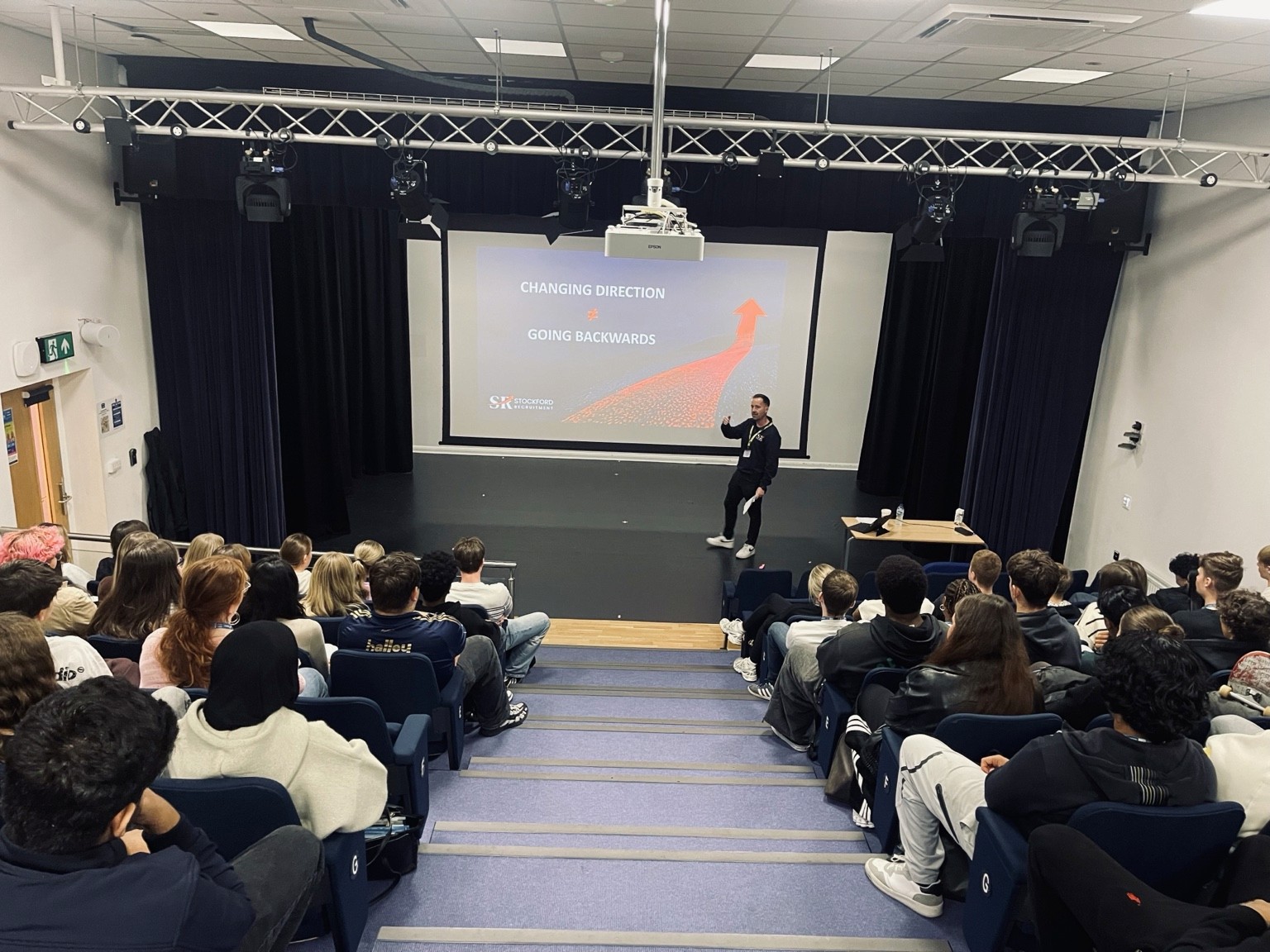
At the beginning of the month, Stockford Recruitment founder Oli Stockford visited Cardinal Newman College in Preston to speak to around 150 second-year Business students across two sessions.
The talk focused on careers, resilience, taking opportunities and preparing for life after education.
Oli shared his own journey from college through to starting Stockford Recruitment, including changing courses, experiencing setbacks and discovering a career he hadn't even known existed when he was younger.
There was also practical advice around CVs, LinkedIn, interviews, researching employers and using AI to prepare for applications.
One of the main messages was that young people don't need to have their entire lives planned out at 17 or 18.
They just need to start thinking about their next step.
The visit is the beginning of something we want to do more of.
We're planning further engagement with local colleges, including smaller practical workshops to help students prepare for entering the workplace.
Recruitment gives us an interesting perspective because we speak to employers and candidates every day.
We hear what businesses are looking for, why people struggle to secure opportunities and what makes candidates stand out.
If we can use some of that knowledge to help young people before they even start their careers, that's something worth doing.
What are we expecting as we head towards the end of 2026?
We're heading into the final couple of months of the year with plenty happening.
There are still businesses recruiting, particularly where they need specialist skills or people who can make an immediate contribution.
We're also starting to have more conversations about hiring plans for 2027.
One thing we'd encourage businesses to think about is preparation.
If you know you're likely to need somebody in January or February, there's no reason to wait until then to start understanding the market.
How available are the people you need?
What salaries are they expecting?
How long are their notice periods?
Are your requirements realistic?
What are competitors offering?
Those conversations can make a huge difference when the time comes to recruit.
And for candidates, the message is similar.
If you're considering a move in the new year, now is a good time to start thinking about what you actually want from your next role rather than waiting until you're desperate for a change.
Final thoughts
October has been a good reminder of how varied recruitment can be.
One day we're discussing embedded software and real-time operating systems.
The next we're speaking to somebody about GPU infrastructure, international financial regulations or how they've built a sales pipeline from scratch.
And somewhere in between, we're talking to 150 college students about what they might want to do with their lives.
That's one of the things we enjoy most about what we do.
Every business is different. Every person is different. And every recruitment process presents its own challenges.
As Stockford Recruitment continues to grow, our focus remains the same.
Understand the business.
Understand the person.
Be honest about what works and what doesn't.
And build relationships that last beyond a single placement.
We'll be back next month with another update on what we're seeing across Technology, Digital and Go-to-Market recruitment.
Looking to hire?
Stockford Recruitment is a specialist Technology & Digital recruitment partner supporting startups, scaleups and growing businesses globally.
Whether you're actively recruiting or starting to plan your hiring strategy for 2027, we'd be happy to have a conversation.
October has been another busy month at Stockford Recruitment. From specialist Engineering, Infrastructure and international FinTech recruitment to the launch of our new website, business milestones and our first college careers talk, we look back at the hiring trends, challenges and opportunities we've seen across Technology, Digital and Go-to-Market. We also share what's happening behind the scenes at Stockford and what we're expecting as businesses begin planning for 2027.
Blog Brief
The second edition of Stockford Insights takes a look back at October 2026, exploring the latest recruitment trends, challenges and opportunities across Technology, Digital and Go-to-Market. This month's update covers growing demand for specialist Engineering, Infrastructure and AI-related skills, changing expectations from employers, international recruitment opportunities and the importance of thorough candidate assessment. We also share what's been happening at Stockford Recruitment, including the launch of our new website, surpassing £800,000 in revenue and 100 successful placements, our recent visit to Cardinal Newman College in Preston and our continued investment in people, technology and recruitment processes. Finally, we look ahead to the remainder of 2026 and the early stages of 2027, sharing our thoughts on hiring confidence, workforce planning and what businesses should be considering as they prepare for the new year.